CUT&RUN
An antibody binds the target protein → pAG-MNase is recruited to the antibody-bound complex → calcium activates MNase → targeted DNA fragments are released and purified → library preparation adds sequencing adapters → sequencing.
CUT&TAG
The notes focus on histone post-translational modifications as CUT&Tag targets. An antibody binds the target → a secondary antibody binds the primary antibody → adapter-loaded pAG-Tn5 is recruited to the targeted chromatin → magnesium activates tagmentation → fragmentation and adapter insertion → sequencing. Tagmentation incorporates adapters; downstream library amplification and preparation still depend on the protocol.
CUT&Tag has protocol-specific limitations.
- **Off-target Tn5 activity and sample processing. ** CUT&Tag data may exhibit high backgrounds, reflecting Tn5 binding open chromatin and/or mitochondrial DNA (as in ATAC-seq). To avoid nonspecific signal from mitochondrial DNA, it is strongly recommended to use nuclei as opposed to whole cells. Thus, CUT&Tag may require optimization to successfully harvest intact nuclei from the desired cell population. Notably, CUT&RUN can be used to profile both cells and nuclei. So, if the type of cell or tissue you are working with is particularly challenging to dissociate, or if the nuclei are fragile, it may be best to try CUT&RUN.
- **Current protocols do not work for all target classes. ** CUT&Tag generates robust data for histone PTMs, but is unreliable for mapping chromatin associated proteins. Similarly, EpiCypher’s CUTANA CUT&Tag protocol and CUT&Tag Kit are rigorously optimized for histone PTMs, but is not recommended for chromatin-associated proteins. Unfixed/native conditions are not suitable for every experiment. In the original CUT&Tag publication, only histone modifications, NPAT, and CTCF were tested. Many transcription factors are not abundantly expressed, weakly or transiently bind to DNA, or indirectly bind to chromatin. For these cases, chromatin crosslinking and sonication are mandatory steps to detect protein-DNA interactions. Furthermore, most ChIP-validated antibodies are validated to work with crosslinking conditions and may not work well with native conditions because the protein epitope availability in crosslinked conditions can be different than in native conditions. Therefore, switching from X-ChIP to CUT&Tag would need thorough antibody validation to be certain of antibody specificity and sensitivity in unfixed conditions.
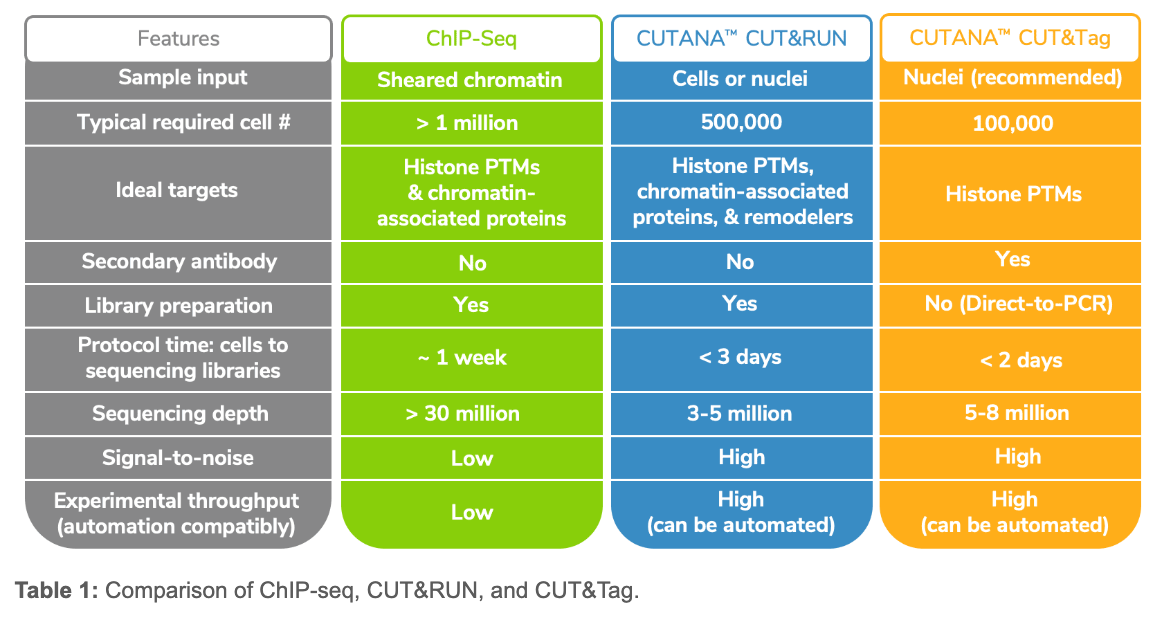
Summary
ChIP-seq:
- Crosslinking and immunoprecipitation can introduce artifacts. Crosslinking may preserve non-specific associations, while non-specific antibody binding may co-precipitate unintended material, increasing background signal.
- DNA purification and library preparation follow immunoprecipitation to prepare the enriched fragments for sequencing.
CUT&Tag:
- The native CUT&Tag workflow discussed here avoids crosslinking and uses targeted Tn5 activity to fragment DNA and insert adapters. Targeted tagmentation can reduce background in suitable experiments, but performance depends on the target, antibody, and sample.
- Tn5 combines fragmentation and adapter insertion in one reaction, simplifying that part of library preparation.
- Low-abundance or transiently associated transcription factors can be challenging targets; the suitability of the protocol needs to be evaluated for the target.
- Crosslinking-based ChIP-seq can be considered for factors associated indirectly with DNA.
CUT&RUN:
- The native CUT&RUN workflow discussed here uses antibody-directed MNase activity to release DNA near the target. Calcium activates the nuclease, and targeted cleavage can limit non-specific background.
- After cleavage, CUT&RUN requires DNA purification followed by library preparation and sequencing. This differs from CUT&Tag, which inserts adapters during tagmentation. The comparison centers on where targeting, fragmentation, adapter insertion, and enrichment occur. Native CUT&Tag and CUT&RUN avoid some crosslinking-associated artifacts, while ChIP-seq can preserve interactions that are difficult to profile under native conditions. Background and sensitivity need to be assessed for the actual experiment. The original CUT&Tag study describes the experimental workflow, including amplification after tagmentation.