Contrasting a thresholded gene-list analysis with a ranked-list view.
Why GSEA? What’s the difference between GSEA and ORA?
ORA approaches have three major limitations:
First, the inclusion criteria for input gene lists are rather arbitrary and typically involves selecting genes that exceed some user-defined statistical cutoff. This risks excluding potentially important genes that for whatever reason fail to reach statistical significance.
Second, ORA approaches use gene names but not any of the rich quantitative information associated with gene expression experiments. In this way, **equal importance is assigned to each an every gene. **
Third, many of the ORA procedures uses statistical procedures that assume independence among genes: Changes in any gene do not affect or are not influenced by any others. Clearly, this is unrealistic for biological systems and has the effect of making ORA procedures more prone to erroneous discoveries or false-positives.
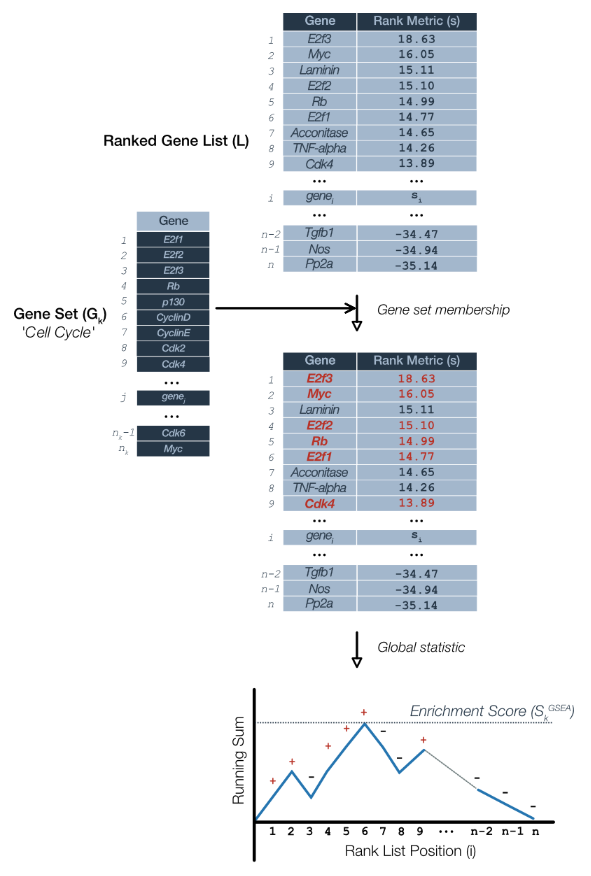
Rank all genes by their expression difference between control and treatment, using the selected log-fold-change statistic.
Plot the gene set along the ranked list. Its members contribute to the running score and appear as barcode-like tick marks.
When larger log-fold changes are placed first and control is the reference level, the left end represents genes increased in treatment. The right end represents the opposite direction. Check the reference level and contrast before assigning that interpretation.